
There is a moment that comes quietly.
You are sitting on the edge of your bed. The house is not loud, but your thoughts are. Your chest feels tight. Not dramatic. Just heavy. You scroll through your phone. You stand up. You sit down again. Something inside you hums — restless, sharp, insistent.
You do not want to die.
You want the noise to stop.
You are not sure what this urge is. You are not sure why pain feels like relief. You are not sure if this “counts” as something serious.
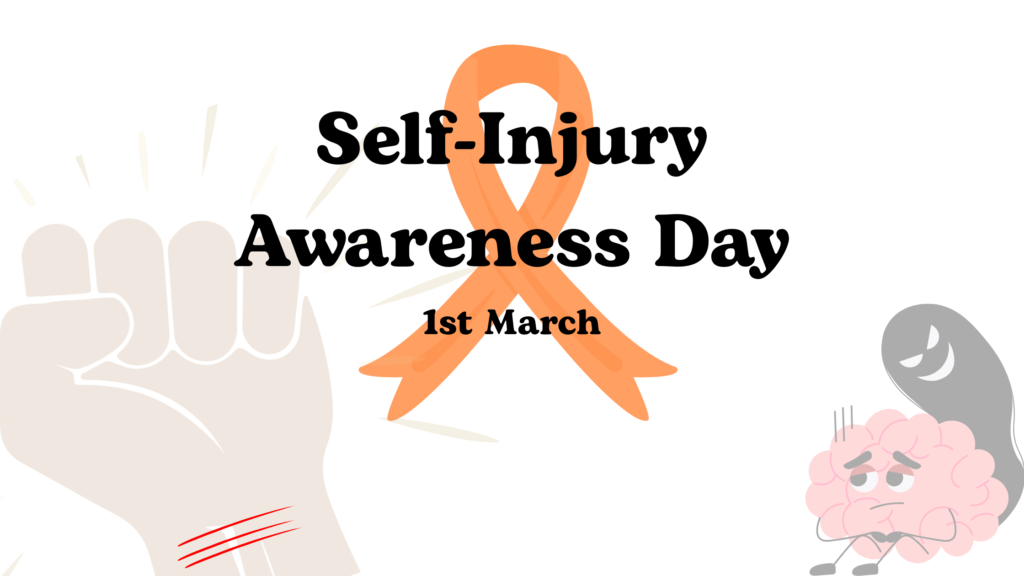
On Self-Injury Awareness Day (March 1), I want to speak to that moment. Not to the statistics first. Not to the diagnosis. But to the quiet edge of the bed.
Sometimes self-injury is not about destruction. It is about urgency. It is about wanting the feeling to end now.
Let us slow it down.
What Self-Injury Actually Means
Self-injury refers to deliberate harm to one’s own body without suicidal intent.
The clinical term is Non-Suicidal Self-Injury (NSSI).
Common behaviors include:
- Cutting
- Burning
- Hitting oneself
- Skin picking until bleeding
- Interfering with wound healing
Self-injury is not a suicide attempt.
Self-injury increases the risk of future suicide attempts.
Research from the International Society for the Study of Self-Injury shows that many individuals report relief after harming themselves. Relief reinforces repetition. Repetition builds habit.
A 2012 study in Psychological Medicine by Whitlock and colleagues found that adolescents often describe self-injury as a way to reduce emotional intensity rather than to seek attention. The behavior regulates affect. The behavior communicates distress.
Self-injury functions as a coping strategy.
Self-injury reduces emotional overload temporarily.
Self-injury creates a cycle of shame and secrecy.
What the Urge Really Is
The urge often appears before the action.
The urge feels like:
- Pressure in the chest
- Heat under the skin
- Sudden numbness
- Racing thoughts
- A need to “punish” oneself
- A desire to see pain on the outside
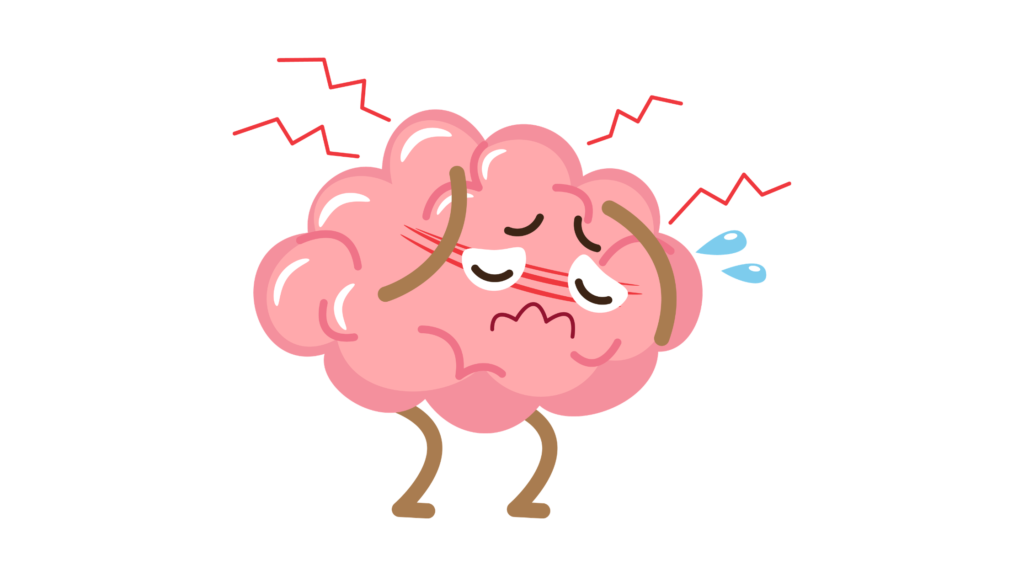
The urge signals dysregulation.
The urge signals emotional flooding.
The urge signals unmet psychological needs.
Research by Klonsky (2007) identified four primary functions:
- Affect regulation
- Self-punishment
- Anti-dissociation
- Interpersonal influence
The brain releases endorphins during injury. Endorphins reduce pain perception. Endorphins produce short-term calm. The nervous system learns quickly.
Self-injury becomes a fast relief tool.
Fast relief tools become hard to replace.
What It Is Not
- Self-injury is not attention-seeking.
- Self-injury is not a personality flaw.
- Self-injury is not weakness.
- Self-injury is not manipulation
- Self-injury is communication without language.
In clinical settings, I often hear:
“I don’t even know why I did it.”
That sentence usually hides:
“I did not know how to say I was drowning.”
Why I Care About This Work
I am a Clinical Psychologist working in private practice and research settings. I have worked with adolescents and adults who struggle with emotional regulation, trauma histories, depression, autism, and anxiety disorders. I have contributed to mental health research projects in collaboration with national and international institutions. My work integrates evidence-based therapy with cultural understanding and developmental psychology.
I do not see self-injury as a “behavior problem.”
I see self-injury as a signal.
Clinical work has shown me one truth repeatedly: when we reduce shame, we reduce harm.
What Helps Instead
-
Delay the action by 10 minutes.
Urges peak and fall like waves. Most urges reduce within 20 minutes. -
Change body temperature.
Cold water on the face activates the dive reflex. The dive reflex slows heart rate. -
Use competing sensations.
Hold ice. Snap a rubber band. Press a cube of soap into your palm.
Competing sensations interrupt automatic behavior. -
Name the emotion specifically.
Replace “bad” with “ashamed,” “rejected,” or “overwhelmed.”
Labeling emotion reduces amygdala activation. -
Remove tools from easy access.
Increased distance reduces impulsive action. -
Track patterns.
Record trigger, emotion, urge intensity, and outcome.
Pattern awareness increases control.
When to Seek Professional Help
Seek therapy if:
-
Urges occur weekly or more.
-
Injuries require medical attention.
-
You feel unable to stop alone.
-
Depression or trauma symptoms persist.
-
You experience suicidal thoughts.
Early intervention improves outcomes.
Integrated therapy reduces long-term risk.
A longitudinal study in The British Journal of Psychiatry (Mars et al., 2014) found that repeated self-harm in adolescence strongly predicts adult mental health difficulties. Timely treatment interrupts that trajectory.
The Quiet Truth
In The Body Keeps the Score, Bessel van der Kolk writes, “Being able to feel safe with other people is probably the single most important aspect of mental health.”
Self-injury often grows in isolation.
When someone finally says, “I wanted the feeling to stop,” the room changes. The urge loses some of its power. Light enters the conversation. Not dramatically. Just enough.
You do not need to punish yourself to prove you are hurting.
You do not need scars to validate your pain.
Why Self-Injury Awareness Day Matters
Self-Injury Awareness Day exists to reduce stigma.
Self-Injury Awareness Day promotes early support.
Self-Injury Awareness Day encourages informed conversations.
Awareness alone is not enough. Access matters. Education matters. Compassion matters.
If you recognize yourself in this article, you are not broken. Your nervous system learned a strategy. Therapy can teach a safer one.
If you are a parent, teacher, or partner reading this, respond with curiosity. Ask, “What was happening just before the urge?” That question opens doors.
Final Words
Sometimes the urge is not about pain. It is about silence. It is about wanting the storm to pause.
If you are ready to replace secrecy with understanding, I offer a space where your experience will be met with clinical knowledge and human warmth. Therapy works best when science and story sit in the same room.
On this Self-Injury Awareness Day, let us choose language over wounds. Let us choose skill over shame. Let us choose connection over concealment.
And if tonight you find yourself on the edge of the bed again — pause. The urge will crest. The wave will fall. You can learn to ride it.
