
what if dementors were real?
Disclaimer: This piece explores themes of trauma and emotional distress. If this feels heavy for you, please go slowly or pause as needed.
This blog is not a substitute for therapy or professional guidance. It reflects the author’s perspective, and your experiences may be different—and equally valid.
Trauma is layered and multifaceted, and this blog only touches on a small part of that experience.
There are stories that entertain, and then there are stories that quietly sit beside your inner life, waiting for the moment you are ready to understand them.
Harry Potter and the Prisoner of Azkaban is one of those stories.
I did not notice it the first time I watched it. Or the second. But recently, in a slower viewing, the film began to feel less like fantasy and more like a clinical room with dim lighting—where memory, fear, and safety were being negotiated in symbols rather than words.
I work as a clinical psychologist. I work with individuals who carry experiences that do not sit quietly in the past. I am also involved in research and structured intervention work, where patterns of distress, recovery, and resilience are not just observed but carefully documented. This dual lens, practice and research, changes how stories appear. They stop being fiction. They begin to resemble case material.
Dementors as trauma responses
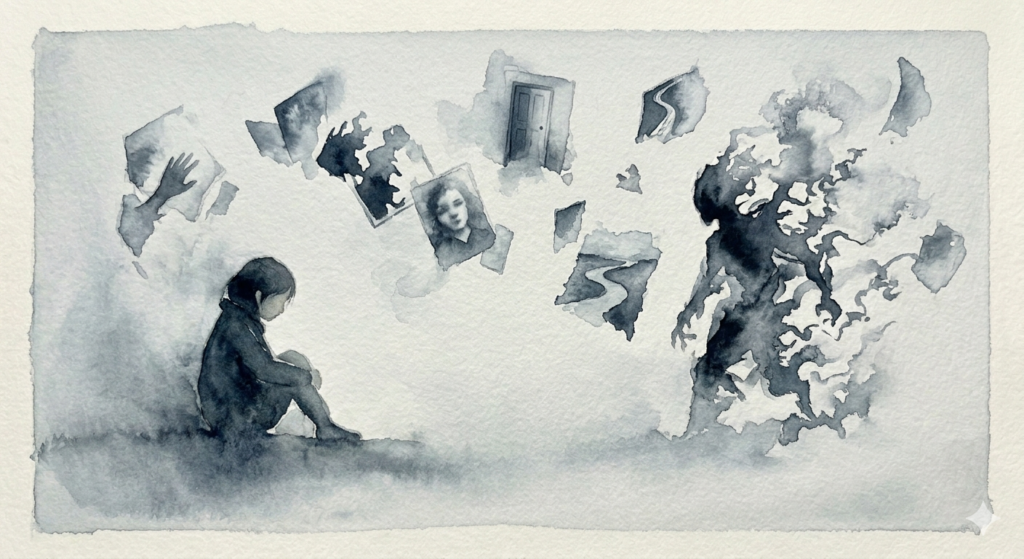
Dementors represent intrusive emotional states. Dementors induce intense fear, paralysis, and despair. Dementors trigger past memories without consent.
This pattern closely resembles trauma responses.
Trauma memories do not behave like ordinary memories. Trauma memories are sensory, fragmented, and emotionally charged. Trauma memories return through triggers such as sound, smell, or situation. Trauma responses activate the body before conscious thought appears.
In clinical literature, this aligns with what The Body Keeps the Score describes. The brain stores overwhelming experiences in a non-linear form. The body reacts as if the event is happening again.
Dementors do something similar. They do not attack the body first. They drain meaning, hope, and emotional stability.
“They drain peace, hope, and happiness out of the air around them.” — Remus Lupin
That line could sit comfortably in a trauma textbook.
The Patronus as emotional regulation
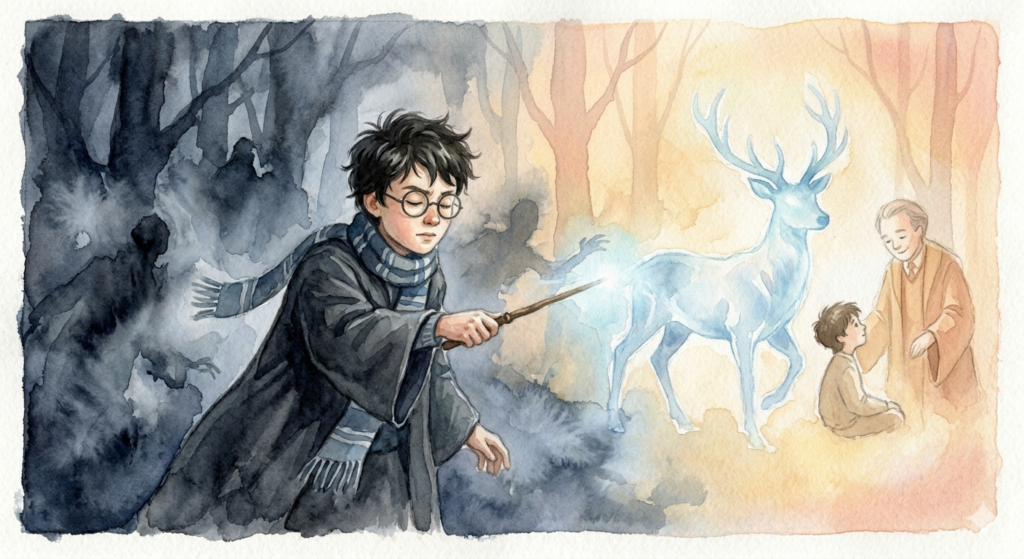
The Patronus Charm is not a spell of force. The Patronus Charm is a practice of emotional recall. The Patronus Charm requires focused attention on a positive internal state.
This mirrors trauma-informed techniques.
Therapeutic work often includes memory resourcing. Memory resourcing involves recalling a safe or positive experience. Memory resourcing activates neural pathways linked to safety. Memory resourcing reduces physiological arousal.
Approaches like EMDR (Eye Movement Desensitization and Reprocessing), developed by Francine Shapiro, use similar principles. The client accesses distress while holding onto a stabilizing memory or sensation. The mind learns that fear and safety can coexist without collapse.
Professor Lupin teaches Harry a version of this.
He does not say, “fight the Dementor.”
He says, remember something powerful.
The uncertainty of memory
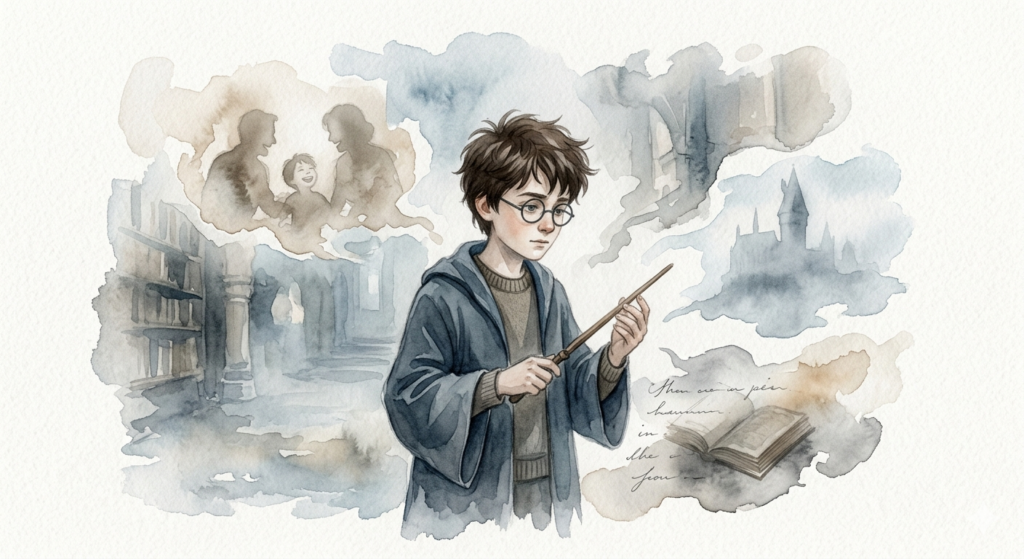
Harry hesitates. First, he thinks of a memory he knows is real, but that was not enough; he had to think of something more emotionally provoking. He thinks of something too positive emotionally but he is not sure weather that is a real memory or not. And i think that is al it matters.
This detail matters more than the magic.
Trauma work does not depend on perfect recall. Trauma work depends on emotional experience. The brain responds to felt safety more than factual precision.
Harry’s Patronus becomes strong not because the memory is verified, but because the feeling is real.
That is a quiet truth many people miss.
Practical translation for real life
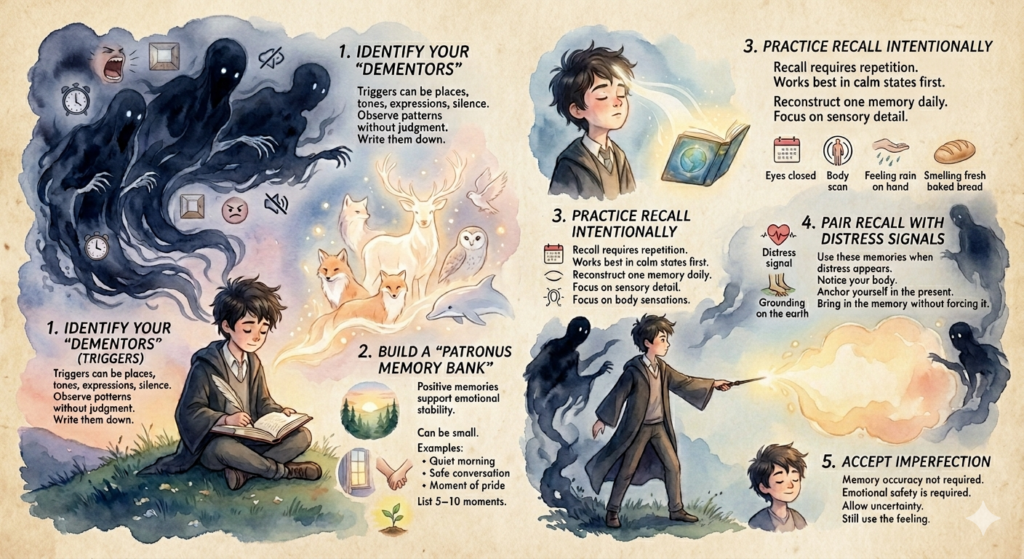
You do not need a wand. You need a structured way to work with your mind.
Here is how this metaphor becomes practical:
1. Identify your “Dementors”
Triggers exist in daily life. Triggers can be places, tones, expressions, or silence.
You can write them down. You can observe patterns without judgment.
2. Build a “Patronus memory bank”
Positive memories support emotional stability. Positive memories can be small.
Examples include a quiet morning, a safe conversation, or a moment of pride.
You can list 5–10 such moments in detail.
3. Practice recall intentionally
Recall requires repetition. Recall works best in calm states first.
You can close your eyes and reconstruct one memory daily.
Focus on sensory detail. Focus on body sensations.
4. Pair recall with distress signals
You can use these memories when distress appears.
You can notice your body. You can anchor yourself in the present.
You can bring in the memory without forcing it.
5. Accept imperfection
Memory accuracy is not required. Emotional safety is required.
You can allow uncertainty. You can still use the feeling.
A softer, more human reading
There is a scene where Harry hears his mother’s voice before collapsing. It is not just sorrow. It is proximity. It is closeness to something lost, something unfinished.
Trauma often carries that quality. It is not always loud. Sometimes it whispers.
And then, later, by the lake, Harry sees someone cast a Patronus powerful enough to drive away a swarm of darkness.
He thinks it is his father.
It is not.
It is himself.
That moment feels like therapy when it begins to work. You spend years believing safety must come from someone else. And then, quietly, almost reluctantly, you realize you can generate it within.
Why this matters clinically
Stories influence how people understand themselves. Stories shape emotional language. Stories reduce resistance to difficult ideas.
Using familiar narratives like Harry Potter and the Prisoner of Azkaban allows complex psychological concepts to become accessible. This approach supports engagement in therapy. This approach improves recall of coping strategies. This approach reduces stigma around mental health.
My work involves both structured intervention and individual therapy. I see how metaphors change conversations. I see how clients remember a scene long after they forget a technical term.
Closing thought
The film does not say trauma disappears.
The film shows that darkness can return.
But it also shows that something else can be learned.
Not control.
Not perfection.
Just the quiet, practiced ability to say:
I know what this feeling is. And I know something that can stand beside it.
That, more than magic, is what heals.
If you are experiencing overwhelming distress or thoughts of harming yourself, please consider reaching out to a trusted person or contacting a mental health helpline in your area.
