Therapy Insights: What Actually Happens in a Therapy Session?
Many people think about therapy for months before booking their first appointment. Some worry they’ll be judged, others wonder what to say, and some picture a quiet room where someone asks endless questions while they lie on a couch. Reality is usually simpler, more practical, and far more human.
Therapy is a conversation with purpose
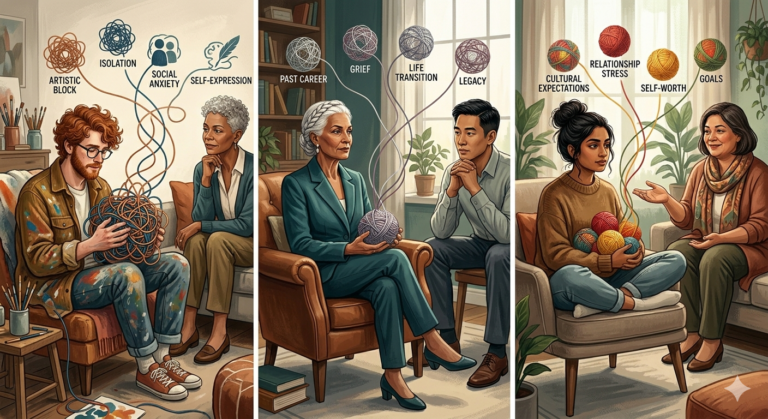
A therapy session helps you understand patterns, emotions, behaviors, relationships, and problems that affect daily life. It provides a structured space for reflection, problem-solving, emotional processing, and behaviour change. The goal is not to tell you how to live, but to help you make choices that feel intentional and aligned with your values.
What happens in the first session: listening, structure, goals
Most people arrive wondering, “Where do I begin?” You don’t need to prepare a speech or know psychological terms. The first session focuses on understanding your current difficulties, history, strengths, relationships, and what you hope to change. The therapist asks questions to clarify how the problem affects your life and to set initial goals. This assessment creates the foundation for later work.
What therapy is and isn’t
Therapy is rarely just advice-giving. Research shows that advice alone has limited long-term benefit; meaningful change usually follows increased awareness plus practised skills and behaviours (e.g., Wampold, 2015; Kazdin, 2007). Therapists help you notice patterns, test alternative beliefs, practise new responses, and build skills, combining insight with action.
Multiple meta-analyses identify common factors predicting therapeutic success: a strong therapeutic alliance, clear goals, regular attendance, client engagement, and evidence-based techniques when matched to the problem (e.g., Lambert & Barley, 2001; Norcross & Wampold, 2011). Trauma-informed and neurodiversity-affirming approaches improve engagement for survivors and autistic clients.
What therapy can feel like
Therapy can include tears, silence, laughter, relief, and small- sudden insights. Bessel van der Kolk’s work reminds us that experiences are stored in both memory and the body; therapy often involves both talking and somatic regulation to change how distress is held (van der Kolk, 2014).
What if I cry, or don’t know what to say?
All reactions are welcome. Crying, silence, confusion, or laughter are normal and useful. Strong emotions may surface because therapy creates a space where you don’t need to hold everything together. Progress doesn’t require dramatic emotion every session; steady small changes matter.
After the session: practice and consolidation
Therapy continues between sessions. Effective change often requires homework (practised skills, behaviour experiments, reflection), just as physical training needs regular practice to produce change. Small behaviour shifts, like boundary-setting or noticing automatic self-critical thoughts, accumulate into lasting change.
Clear takeaways for readers
You don’t need a life story to start. Bring one or two examples of what’s bothering you now.
Therapists will ask about history, relationships, and strengths — that helps tailor interventions.
Expect both insight and homework; therapy is collaborative.
Early change often looks like small shifts; track them (mood ratings, behaviour logs).
If therapy feels mismatched, share feedback with your therapist or consider a different approach — fit matters.
When therapy works best
Therapy is most effective when the client and therapist work together: clear, measurable goals; regular attendance; honest feedback; and between-session practice. Research shows this collaborative, active approach produces better outcomes than passive or purely advice-based models.
About me
I’m Vaishnavi Dang, a Clinical Psychologist registered with RCI. I work with adults, adolescents, and children across anxiety, OCD, trauma-related concerns, neurodiversity, and life transitions. My clinical work is informed by research and community mental health collaborations (NIMHANS, UNICEF). If you’re curious whether therapy might help, you can book a short, introductory 15-minute call to see if we’re a good fit.